






Imagine 9 p.m.; the time when almost all the residents of the tower have returned home and Internet usage is at its peak. Someone is having an online meeting, someone is streaming a high-definition movie, several people are playing online games at the same time, and in the meantime, the security guard needs to have uninterrupted video from the CCTV cameras. Now, if the Internet drops or fluctuates, dissatisfaction starts like dominoes from one unit and very quickly reaches the entire building. This is where the main question arises: is it better for a tower to have “regular unit-to-unit Internet” or “tower Internet” that is provided to the entire building in an integrated manner?
The truth is that the problem with towers is not just “speed.” Many building managers, when they are dissatisfied with the Internet, go for a higher speed number; but experience shows that in towers, three factors are more important than the speed number: stability during busy hours, actual capacity when used simultaneously, and the quality of Internet distribution within the building. If these three factors are not managed properly, even high-speed Internet on paper can become annoying in practice.
Why does regular internet in towers often not work?
Typical internet means each unit is serviced separately, has its own modem, and any problems are followed up with their service provider’s support. This model is acceptable for independent homes, but in towers it usually becomes a hassle for three main reasons.
1. The first reason is the dispersion of management.
In a tower, dozens of units may use different service providers. When the quality of the Internet drops or an outage occurs, it becomes difficult to determine where the problem is and instead of the issue being resolved quickly, it becomes an eroding argument between the residents, the building manager and the operators. On the other hand, when the Internet of common spaces such as the lobby or security is also dependent on a single Internet or regular lines, it becomes even more difficult to take responsibility and handle it more carefully.
2. The second reason is the unequal experience of residents.
In a high-rise building, the quality of lines and equipment is not the same between units. One unit may have a very good experience, while another unit may experience a sharp drop during peak hours. This difference in experience creates dissatisfaction and comparisons, and ultimately puts pressure on building management, as residents expect to have an acceptable and close level of quality “in the same tower.”
3. The third reason is the problem with the tower’s internal network.
What many people confuse with “weak internet”. Towers usually have a large number of modems and Wi-Fi networks. This congestion causes frequency interference, poor connection quality, delays, and disconnections. As a result, even if the incoming internet is good, the user experience is bad due to the poor distribution and congestion of Wi-Fi. This is why in towers, simply buying a higher speed usually does not work wonders.

What is tower internet and how is it different from regular internet?
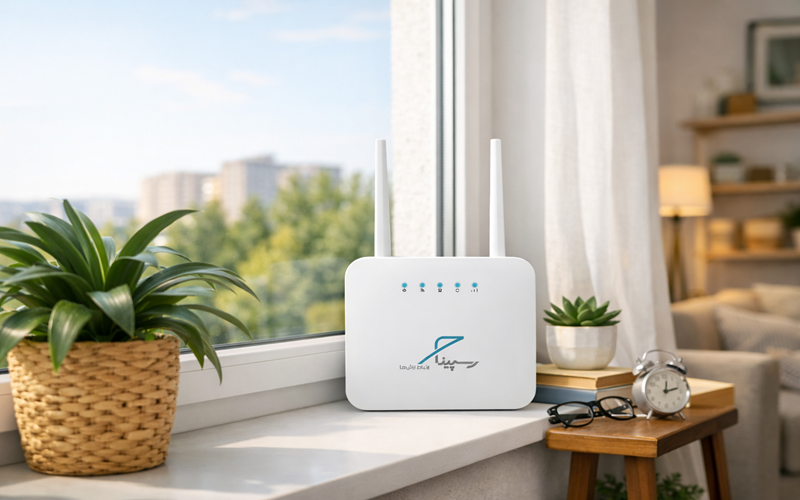
Tower Internet is a specialized model for multi-unit buildings that provides Internet as a central service for the entire tower, rather than providing it unit by unit and scattered, and then distributes it throughout the building in a systematic manner. In Respina’s Tower and Complex Internet Service, Internet is provided in the form of radio Internet with dedicated bandwidth for the building, and then appropriate equipment (such as an access point/access solution) is provided to each house to connect the units so that they have a stable connection and better coverage.
Simply put, tower internet is like you’re building an “internet backbone” for a building; something whose capacity and stability are designed for a collective use, not a single family. Then, properly distributing it inside the building makes the quality of the connection to the units more logical and controllable.
Why is tower internet better for towers?
Better stability and performance during peak hours
The main problem in towers is that simultaneous consumption increases and distributed services are usually not managed in a coordinated and planned manner. Since tower internet is designed and provisioned for the entire building, it allows for greater capacity planning and a more consistent experience. In practice, when internet is provided to the tower in a dedicated and centralized manner, the likelihood of severe and unpredictable drops is reduced and the resident experience is more reliable.
Experience integrity
When units each have different services, the quality and type of experience becomes heterogeneous and building management cannot rely on a single standard. But in the Internet of Towers, you have a common infrastructure. This makes the overall quality of the building more predictable and reduces the difference in experience between units. This is an important advantage, because in towers, “the same quality that is acceptable to everyone” is itself a factor of peace and satisfaction.
Indoor distribution quality
Many internet problems in towers come not from the “operator” but from the “internal network”: Wi-Fi interference, poor coverage, blind spots, disconnections and reconnections when moving between rooms or floors. When the tower Internet model is implemented and a connectivity solution (such as an access point) is considered for the units, the internal network becomes organized and the user experience improves. Here you haven’t just bought internet; you’ve built a communications solution for the building.
Excellent compatibility with common building needs
Towers usually don’t just want “Internet for mobile and laptop.” CCTV cameras, traffic control, security panels, smart systems, parking management, even signs and monitoring equipment, all require stable internet. When the Internet is fragmented and fragmented, these needs either depend on a low-quality, regular line or are disrupted during crises. But because the tower internet is centralized and more reliable, it provides a more suitable infrastructure for these applications and also brings more peace of mind to the building manager.
For which towers is tower internet most essential?
If your tower has a high number of units or is used for office/commercial purposes, the need for stable internet is usually more serious. Also, if your building relies on security systems like CCTV and access control, or if many residents work remotely, stream, or play online games, tower internet can make a significant difference. In areas where the quality of fixed lines is poor or the capacity of conventional services is not responsive, dedicated radio internet for towers can be a more logical solution.
A common mistake: Just looking for “more speed”
Many towers, when the internet experiences problems, simply seek to increase the speed number instead of improving the supply and distribution model. But in practice, if the actual capacity is not sufficient during peak hours or the building’s internal network is not designed properly, even a higher speed number will not yield significant results. The Internet of Towers is designed to solve exactly this problem: Providing internet at the “building” scale and principled distribution to units.
What are the features of Respina Towers Internet?
Respina uses a dedicated broadband radio internet model for its tower and complex internet service; that is, the internet is provided exclusively to the entire tower and then a connection solution (such as an access point) is provided to each unit to create a better connection experience and more appropriate coverage. This approach is both attractive to residents because they receive more acceptable quality, and valuable to the building manager because it provides an integrated and trackable service.
Last question: After all, is tower internet better or regular internet?
If your building is small, user usage is light, and you don’t have a serious need for stable internet for common areas, regular internet may be sufficient. But if your tower is facing declining nighttime quality, unit dissatisfaction, the need for cameras and traffic control, or Wi-Fi congestion and blind spots, tower internet is usually a more logical and future-proof choice because it solves internet at the actual scale of the tower, not at the scale of a single unit.